
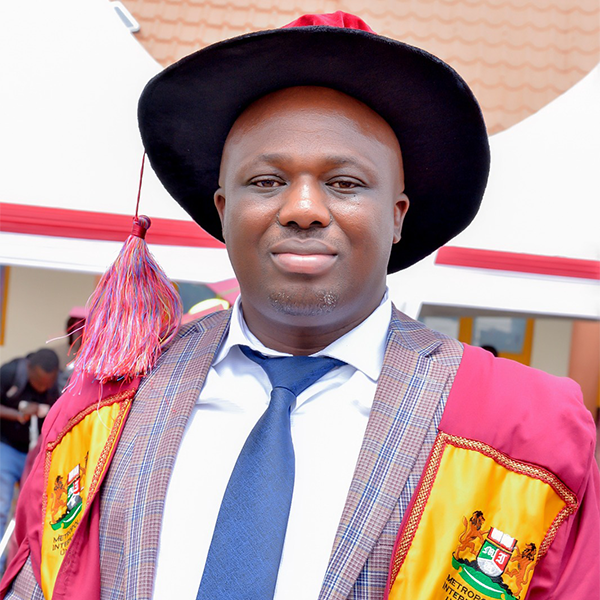
TOUCHING LIVES, BUILDING FUTURES
A Memoir of Dr. Gracious Ariyo Kazaara

There are individuals whose influence is felt not only in the institutions they lead but in the thousands of lives they quietly, persistently transform.
Dr. Gracious Ariyo Kazaara is one such person. Over more than two decades in business administration, entrepreneurship, and higher education management in Uganda, he has woven a legacy that defies simple categorization. He is at once an academic administrator, an employer, a mentor, a sponsor of talent, and a builder of national capacity.
This memoir was compiled to honour the full breadth of that legacy. It draws on institutional records, testimonies from colleagues and students, academic publications, and public addresses to construct a portrait of a man who has never separated personal achievement from communal responsibility.
Where others might have pursued success in private, Dr. Kazaara has consistently turned outward, asking not “What can I gain?” but “Whose life can I change?”. This document is structured thematically and presented using NVivo-inspired qualitative inquiry, drawing out the dominant nodes of his life’s work: Employment Creation, Educational Access, Institutional Transformation, Mentorship, Scholarly Contribution, and National Vision. The intention is not hagiography but honest, evidence-based celebration of impact.
SECTION ONE
Early Foundations: The Making of a Servant-Leader
Long before Dr. Gracious Ariyo Kazaara held any formal academic title, the values that would define his career were already firmly in place: a belief in human potential, a commitment to dignity in work, and a conviction that education is not a privilege reserved for the fortunate but a right owed to every Ugandan citizen. His early career combined business acumen with a quiet but persistent concern for community.
Even as he built his professional credentials in business and administration, he was simultaneously watching, learning, and asking difficult questions about why talented young Ugandans were graduating without employable skills, without entrepreneurial confidence, and without a credible pathway to sustainable livelihoods.
The educational system, he concluded, was producing graduates who expected to find a door already open. He resolved to build doors and then to teach people how to build their own.
This formative conviction that education must produce creators, not merely consumers became the philosophical spine of everything Dr. Kazaara would later accomplish. It informed his curriculum reforms, his employment practices, his advocacy work, and his scholarly writing. It is the thread that runs unbroken through every chapter of his professional life.
Section Two:
Employment Creation and Economic Empowerment
One of the most concrete and measurable dimensions of Dr. Kazaara’s legacy is the employment he has generated not through impersonal market forces but through deliberate, personal acts of investment in people. At Metropolitan
International University (MIU) and Avance International University, he championed the expansion of administrative and academic departments, creating positions that did not previously exist and filling them with individuals he believed in before they fully believed in themselves.
A Culture of Deliberate Hiring
Colleagues who have worked closely with Dr. Kazaara consistently describe a hiring philosophy that prioritizes potential over polish. Where a conventional administrator might scan a CV for credentials and institutional prestige, Dr. Kazaara has been known to hire the recent graduate with no experience but a burning desire to grow, the single mother returning to the workforce after years away, the former student who had no reference except the memory of their own perseverance.
One staff member at MIU, who requested anonymity, recalled: “When I came for my interview, I had no practical experience and I was afraid. Dr. Kazaara told me that experience can be taught but character cannot be manufactured.
He gave me the position. He gave me a chance. Five years later, I am heading my department.” This story is not exceptional. It is representative.
Expanding Staffing Structures at MIU
As University Secretary at MIU, Dr. Kazaara oversaw a significant expansion of the university’s human resource base. Under his tenure, the institution did not merely fill vacancies-it restructured its staffing architecture to ensure that every faculty and administrative unit was adequately resourced. New positions were created in student services, ICT, quality assurance, and online learning administration, each role representing a real income for a real Ugandan family.
The introduction of Open Distance e-Learning (ODEL) at MIU, which Dr. Kazaara pioneered, was itself an employment multiplier. New roles were required: online course developers, digital examination officers, e-learning platform administrators, and remote student support personnel. These were not temporary or contractual positions but permanent additions to the university’s workforce, creating stability for dozens of professionals.
Employment beyond the University Walls
Dr. Kazaara’s employment creation extends beyond the formal university payroll. His entrepreneurship curriculum, which emphasizes practical business skills and venture creation, has resulted in a generation of graduates who have gone on to establish small and medium enterprises, each of which employs others. When Dr. Kazaara speaks of graduating job creators rather than job seekers, he is describing a multiplier effect-one act of education producing many acts of employment downstream.
His research on taxation and small business development has further amplified this impact. By informing policy debates around the tax burdens facing nascent Ugandan enterprises, his academic work has contributed to a more enabling environment for the very entrepreneurs his educational philosophy is designed to produce.
Section Three: Free and Subsidized Education
Perhaps no dimension of Dr. Kazaara’s work carries more emotional weight than his sustained effort to ensure that poverty never becomes a permanent barrier to education. In a country where school fees have historically determined destiny, Dr. Kazaara has worked systematically through institutional mechanisms, personal advocacy, and direct intervention to remove financial obstacles from the path of deserving students.
The Bursary Philosophy
Dr. Kazaara has been a consistent and vocal advocate for bursary and scholarship schemes at every institution with which he has been affiliated. At MIU, he promoted the expansion of bursary arrangements that allowed students from low-income households to access university education without the full weight of tuition fees. His position has always been philosophically clear: a bursary is not charity. It is society’s investment in itself. A graduate from western
Uganda, who benefited from one of these bursary arrangements, shared her experience in a university publication: “I come from a village where my father’s income barely covered food. University was a dream I did not dare speak aloud. Dr. Kazaara’s office found me a sponsorship. I graduated with a Bachelor of Business Administration. I now run a small accounting firm and employ three people. That bursary was not just for me. It was for everyone I have since employed.”
Open Distance e-Learning as a Tool of Equity
Dr. Kazaara’s single most consequential act of educational democratization has been his pioneering of Open Distance e-Learning (ODEL) at Metropolitan International University. Under his leadership, MIU became only the fifth university in Uganda-out of more than thirty-two licensed institutions to receive full ODEL accreditation from the National Council of Higher Education (NCHE).
ODEL was not adopted simply as a technological novelty. Dr. Kazaara understood that the traditional model of university education requiring physical relocation to a campus, regular attendance, and the financial architecture of urban student life was systematically excluding rural Ugandans, working adults, parents of young children, and persons with disabilities.
ODEL dissolved those barriers. Over 1,500 students completed their studies and sat their examinations through online platforms, many of them individuals who would otherwise never have entered a university classroom.
To ensure quality was not sacrificed at the altar of access, Dr. Kazaara implemented rigorous safeguards: anti-plagiarism software to maintain academic integrity, facial recognition and browser lock applications to ensure examination security, and model analysis tools to monitor learning outcomes. The message was clear ODEL graduates from MIU would hold degrees of equivalent rigour and standing to those earned in any lecture hall.
Advocating for Internet Subsidies
Dr. Kazaara recognized early that ODEL could not achieve its equitable potential without addressing the digital divide.
Internet connectivity in rural Uganda remains expensive relative to household incomes. He became one of the most consistent academic voices calling on the government to subsidize internet costs, framing this not as a matter of convenience but of national development policy. A student in Kotido who cannot afford data cannot access the future.
For Dr. Kazaara, that is not a personal failure of the student it is a collective failure of the state.
Section Four: Life-Changing Experiences and Testimonies
Qualitative research of the NVivo kind often reveals that the most significant impacts of an institution or its leaders cannot be captured in enrolment statistics or graduation rates. They are found instead in the texture of individual stories-the before and after of lives genuinely altered by an encounter with a mentor who believed in them before they believed in themselves.
The Student Who Was Going to Drop Out
Among the many stories associated with Dr. Kazaara’s leadership is that of a student who, midway through his second year at MIU, appeared at the university secretariat intending to withdraw. His family had run out of funds. His father had lost his trading business. He saw no path forward. A junior staff member, rather than processing the withdrawal form, escorted the student to Dr. Kazaara’s office.
What followed was a two-hour conversation in which Dr. Kazaara did not merely arrange emergency financial support-he helped the student map out an alternative financial strategy, identify part-time income opportunities compatible with his studies, and access a partial bursary that had not been widely publicized.
The student completed his degree. He later returned to the university as a guest speaker at an entrepreneurship seminar, having launched a small logistics company. He credited that single afternoon in Dr. Kazaara’s office as the moment his life changed direction.
The Administrative Staff Member Who Found Her Voice
A long-serving member of the university’s administrative team described how Dr. Kazaara personally supported her enrollment in a part-time degree programme while she continued working. “He told me that my job title did not have to be my ceiling.
He arranged a reduced tuition contribution from the university, adjusted my working hours so I could attend evening classes, and checked on my academic progress the same way he checked on the university’s financial reports-regularly and seriously. I have my degree now. But more than that, I have self-respect that I never thought I deserved.”
The Rural Teacher Who Accessed His Masters Online
The ODEL programme made possible a transformation that face-to-face education could not have achieved. A primary school teacher from a rural district in western Uganda, who had been teaching for eleven years without a university degree, enrolled in MIU’s ODEL Master of Business Administration programme. He attended no physical lectures.
He sat examinations in a physical hall. He graduated. In a letter to the university, he wrote: “I used to feel invisible in the education system because I had no university certificate. Headteacher who knew less than me were promoted above me. Dr. Kazaara’s ODEL programme gave me the credential that society demanded. I have since been promoted twice and am now mentoring younger teachers in my district to pursue the same path.”
Prayer Day and the Pastoral Dimension of Leadership
At a university-wide Prayer Day at Avance
International University in October 2025, Dr. Kazaara delivered a message that many attendees described as personally transformative. Rather than the conventional administrative address, he spoke directly to students about purpose, resilience, and the courage required to pursue goals in the face of discouragement.
His words “Continue the right path and focus on your goals passionately and with purpose” were received not as institutional rhetoric but as genuine pastoral counsel from someone who had clearly walked his own difficult road.
Section Five: Institutional Transformation at MIU and Avance
Institutional transformation is among the most difficult achievements in any professional career. Universities are, by nature, cautious institutions. They resist rapid change, cling to established curricula, and often treat administrative innovation with suspicion. It is against this backdrop that Dr. Kazaara’s record of genuine institutional transformation must be understood and appreciated.
The Holistic Entrepreneurial Curriculum
As University Secretary at MIU, Dr. Kazaara was the principal architect of a curriculum philosophy that challenged the prevailing Ugandan model of higher education. Where most universities were producing graduates trained primarily for employment in formal sector organizations, Dr. Kazaara championed a fundamentally different vision:
The holistic, entrepreneurial curriculum. This model embedded practical business skills, venture creation modules, financial literacy, and innovation thinking into degree programmes across multiple faculties.
The rationale was straightforwardly pragmatic. Uganda’s formal employment sector cannot absorb the volume of graduates produced annually by its universities. If every graduate expects a salaried position, the arithmetic of national unemployment is inevitable. The entrepreneurial curriculum was Dr. Kazaara’s structural response to this reality: equip graduates to build enterprises, and the employment problem begins to resolve itself from the inside.
ODEL: A National Milestone
The achievement of ODEL accreditation under Dr. Kazaara’s leadership was not merely a procedural accomplishment.
It positioned MIU among an elite group of Ugandan universities with the infrastructure, academic governance, and technological capacity to deliver credible online education. The accreditation process, overseen by the National
Council of Higher Education, requires rigorous institutional readiness reviews. That MIU succeeded as only the fifth institution in the country to do so is a testament to the thoroughness of the groundwork Dr. Kazaara laid.
Quality Assurance Systems
Dr. Kazaara’s commitment to quality is visible in the systems he has implemented across both institutions. The introduction of anti-plagiarism software institutionalized academic integrity. Facial recognition and browser lock technologies for online examinations established assessment credibility. These were not mere technical additions they were cultural signals to staff and students that standards at MIU and Avance were non-negotiable.
Governance at Avance International University
In his capacity as Chairperson of the Board of Directors’ Committee at Avance International University in Wakiso District, Dr. Kazaara has demonstrated that governance is not a passive oversight function but an active institutional stewardship role. He has shaped board culture, championed transparency in institutional decision-making, and ensured that strategic planning processes are grounded in the realities facing Ugandan higher education rather than borrowed wholesale from foreign models.
Section Six: Scholarly Contributions and Policy Influence
A leader who shapes institutions is significant. A scholar who shapes thinking is transformative. Dr. Kazaara has been both. His research portfolio spans the intersection of education, governance, social development, and entrepreneurship-all domains directly relevant to Uganda’s development challenges.
His publications are not exercises in academic abstraction. They are practical interventions, designed to inform how schools are run, how students are supported, how teachers are motivated, and how policy is designed.
Key Research Areas
His published research addresses the following critical domains:
• Strategic change management in higher institutions: Examining how universities in sub-Saharan Africa can navigate structural transitions without losing institutional coherence or academic quality.
• Student enrollment and graduation trends: Analyzing the factors that drive student retention and completion, with particular attention to financial barriers and institutional responsiveness.
• The impact of COVID-19 on the education system: A rigorous investigation of how the pandemic disrupted learning in Uganda and the long-term policy implications for educational continuity planning.
• Peer pressure and early marriages among school-going children: Addressing the social dynamics that remove girls, in particular, from the education pipeline before they can realize their full academic potential.
• Teacher motivation and academic performance: Investigating the causal relationship between how teachers are treated, compensated, and valued, and the quality of learning outcomes they produce.
• Taxation and small business development: Examining how tax policy affects the viability of small enterprises and what reforms could better support Uganda’s informal and semi-formal business sectors.
Section Seven: Mentorship and the Architecture of Belonging
In the field of leadership studies, mentorship is often discussed in instrumental terms as a mechanism for transferring knowledge, building capacity, or accelerating career progression. Dr. Kazaara’s approach to mentorship transcends these frameworks.
For him, mentorship is less a technique than a disposition: a willingness to see the fullness of a person before their portfolio confirms it, and to invest in their development not because the return is guaranteed but because the investment is right.
Mentoring Through the Curriculum
Dr. Kazaara’s curriculum innovations were themselves acts of mentorship at scale. By embedding entrepreneurship, personal development, and practical skill-building into degree programmes, he created learning environments in which students were not merely taught content but encouraged to discover their own capacities.
Faculty were guided to see themselves not as knowledge transmitters but as mentors whose role included challenging students to exceed their own expectations.
Individual Mentorship: The Personal Touch
Beyond structural approaches, Dr. Kazaara has been noted by colleagues and students alike for the personal quality of his mentorship. He maintains genuine interest in the progress of individuals he has supported, following up not through formal reporting mechanisms but through the kind of direct, human-scale engagement-a phone call, a brief meeting, a word of encouragement at a public ceremony that communicates authentic care rather than institutional obligation.
A junior lecturer at MIU described how Dr. Kazaara guided her through her first academic publication: “He did not edit my paper for me. He sat with me and asked questions that made me see the weaknesses myself. He said the best kind of help is the kind that makes you stronger, not the kind that makes you dependent. I submitted that paper, it was accepted, and I understood for the first time what academic confidence feels like.”
Section Eight: National Vision and Uganda’s Future
Uganda’s Vision 2040 identifies human capital development as a foundational pillar for transforming the nation into an upper-middle-income country. It calls for a workforce that is skilled, productive, and capable of participating meaningfully in a competitive global economy. Dr. Kazaara has not merely endorsed this vision-he has operationalized it, translating a national aspiration into concrete institutional practice.
Education as the Engine of Vision 2040
Dr. Kazaara understands that no development vision however ambitious or well-funded can succeed without the human capital to implement it. Engineers, entrepreneurs, administrators, teachers, and healthcare workers, policymakers: all of these must emerge from an education system that takes both access and quality seriously. His work at MIU and Avance is in direct service of this understanding. His ODEL programme has extended university access to populations previously excluded by geography and economics.
His entrepreneurial curriculum has produced graduates with the disposition and skills to create enterprises. His scholarship has contributed to the evidence base that informs national education policy. His employment creation has generated livelihoods within the communities his institutions serve. In sum, Dr. Kazaara is not working towards Vision 2040 he is embodying it.
Advocacy for Structural Change
Dr. Kazaara has not confined his contribution to what can be achieved within institutional walls. He has been an active participant in national conversations about education policy, consistently advocating for positions that prioritize equity, quality, and long-term national development over short-term institutional advantage.
His calls for government internet subsidies, for expanded student loan schemes, and for national recognition of ODEL as a credible and valued mode of learning represent contributions to policy discourse that extend well beyond any single university.
Section Nine: Character, Values, and the Personal Philosophy of a Servant-Leader
Institutions are ultimately shaped by the people who lead them, and the quality of those people is ultimately determined not by their credentials but by their character. Those who have worked most closely with Dr. Kazaara describe a leader defined by the consistency between what he professes and what he practices-a quality that is rarer in public life than it ought to be.
Integrity in Practice
In an environment where academic administration is sometimes associated with opacity and self-interest, Dr. Kazaara has been noted for his transparency in decision-making, his willingness to acknowledge institutional challenges publicly, and his refusal to prioritize personal advancement over institutional welfare.
Colleagues describe a leader who is as willing to take responsibility for failures as he is to celebrate successes a disposition that creates psychological safety within teams and builds genuine trust across institutional communities.
The Discipline He Teaches
Dr. Kazaara’s personal research on discipline as a component of human capital development is not an abstract academic exercise. It reflects a value he has embodied throughout his own career. He has maintained extraordinary productivity simultaneously managing administrative responsibilities at multiple institutions, pursuing an active research agenda, and providing direct mentorship to staff and students without apparent sacrifice of quality in any domain.
This discipline is itself a form of teaching: a demonstration, visible to all who work with him, of what principled commitment to one’s purpose looks like in practice.
Compassion without Weakness
Perhaps the most distinctive quality attributed to Dr. Kazaara by those who know him well is his capacity for compassion without sentimentality. He is genuinely moved by hardship and genuinely committed to alleviating it. But his compassion is expressed not through sympathy alone but through action: finding bursaries, restructuring curricula, creating jobs, advocating for policy change. He believes, and has said explicitly, that feeling for someone is only the beginning. The obligation is to act.
Section Ten: Legacy
What Remains When the Work Is Done
When historians of Ugandan higher education look back at the early decades of the twenty-first century, they will encounter a landscape of extraordinary challenge and considerable achievement. They will find a country that was navigating the intersection of demographic growth, technological change, economic aspiration, and educational reform. And in that landscape, they will find, if they look carefully enough, the unmistakable fingerprints of Dr.Gracious Ariyo Kazaara.
His legacy is not a single monument but a constellation of them: the student who almost dropped out and instead built a company; the rural teacher who earned his master’s online and now mentors others; the administrative officer who earned her degree while working and found self-respect she did not know she deserved; the over 1,500 students who completed their studies through ODEL without ever being told that geography had made their ambitions impossible; the scores of staff members who were hired not because they had already arrived but because someone believed they were on their way.
The institutions Dr. Kazaara has shaped Metropolitan International University and Avance International University are themselves his legacy, not as structures of brick and administration but as living, learning communities with values baked into their foundations: the value of access, the value of quality, the value of entrepreneurship, the value of integrity.
And his scholarly legacy will outlast his administrative tenure. The research he has published on change management, teacher motivation, student access, pandemic resilience, and small business development will continue to be cited, debated, and built upon by scholars and policymakers long after the specific institutions in which he worked have themselves evolved beyond recognition. But perhaps the deepest legacy is the simplest.
It is the idea that a leader’s measure is taken not in the honours they receive but in the lives they change. By that measure, Dr. Gracious Ariyo Kazaara has accumulated a wealth that no certificate can quantify and no institutional title can contain.
A Nation Shaped One Life at a Time
Nations are not built in parliaments alone. They are built in classrooms and laboratories, in administrative offices where a worried student is heard rather than processed, in the decision to give someone a job before they are perfect for it, in the late-night phone call that tells a young lecturer her paper is worth submitting. Nations are built by people like Dr. Gracious Ariyo Kazaara not in grand gestures but in the patient, relentless, human-scale work of touching one life at a time.
This memoir has attempted to capture the breadth and depth of that work. It has not sought perfection of portraiture no biography of a living leader can be complete. What it has sought is honesty: an honest accounting of what this man has built, who he has helped, what he believes, and why his story matters to everyone who cares about Uganda’s future.
In the NVivo framework of this analysis, the dominant theme that emerges across every node, every sub-node, every coded passage of testimony and institutional record, is this: Dr. Gracious Ariyo Kazaara has not merely led institutions.
He has led people. And in doing so, he has quietly, persistently, irresistibly helped build a nation
Author: MIU Journals (journals.miu.ac.ug)